MBUSD Budget Corner
The Manhattan Beach Unified School District has reintroduced the Budget Corner as a recurring feature in the Superintendent’s Newsletter. This series is designed to provide transparency and helpful context around the District’s financial landscape.
To support easy access and transparency, information from each Budget Corner featured in the Superintendent’s Newsletter will be pulled together and housed on this page. Below, we highlight the Budget Corner entries from each Superintendent’s Newsletter.
An Overview of State Funding and Local Support | January 9, 2026
Background Information:
Despite strong academic outcomes, MBUSD remains one of the lowest-funded school districts in California when it comes to state funding. Through the State’s Local Control Funding Formula (LCFF), MBUSD receives significantly less funding than many neighboring districts, making us the lowest-funded district in Los Angeles County and the second lowest-funded unified district in the state.
The LCFF accounts for approximately 66% of the District’s total revenue. Nearly all of the remaining 36% is considered restricted funding, meaning those dollars can only be used for specific, state-designated purposes and cannot be redirected to address broader District needs.
While the State provides annual Cost-of-Living Adjustments (COLAs), these increases do not keep pace with the real cost of operating schools. Each year, districts experience natural growth in expenses, but state funding adjustments often fall short of covering those increases, creating ongoing budget pressure.
LCFF funding is based on a per-pupil amount, with additional funding provided for students who are English Learners, eligible for Free or Reduced-Price Meals, or in foster care (referred to as the Unduplicated Count). MBUSD has a relatively small number of students in this category, which significantly limits the amount of supplemental funding the District receives.
As a result, funding disparities across the region are substantial. Some neighboring districts receive up to 5.5 times more funding per student than MBUSD, despite serving similar geographic areas. With this said, we also acknowledge that these surrounding districts are considered higher need in comparison to MBUSD. These structural funding challenges, combined with rising costs, create ongoing financial strain, even as the District continues to deliver strong academic outcomes and maintain responsible fiscal stewardship.
Importance of Local Support:
To help offset the limitations in state funding, MBUSD has relied on the strength of our local community and partnerships. One of the most effective strategies has been keeping funding local, allowing our community to help guide priorities and ensure resources align with what we value most for our students.
The exceptional opportunities available across our schools are made possible through the generosity and commitment of our families and community organizations, including support through the Manhattan Beach Education Foundation (MBEF), PTA/PTSA membership drives, and at the high school level, MBX Foundation and booster organizations. This impact is substantial; see some data below:
- MBEF provides over $6.5M per year and in 2025-26 is providing over $7.1M due to strong support of MBEF fundraising efforts, including the Annual Appeal.
- Measure MB provides nearly $2.5M per year
- PTA/PTSAs provide funding for everything from basic classroom supplies to field trips to facility improvements
- Booster clubs and MBX provide the resources needed to support the incredible co- and extra-curricular programs that allow our students to compete and perform at high levels
While these local contributions are essential, they are not unlimited. These funding sources would need to grow by millions of dollars every year in order to keep up with inflationary cost pressures. Rising costs continue to put pressure on District finances. Although some of these increases have been partially offset through reductions in expenses, MBUSD is navigating a challenging financial period. Without a significant increase in sustainable funding, it will not be possible to maintain the level of programs and services that MBUSD offers today.
Understanding the State Budget Timeline | January 16, 2026
This Budget Corner entry provides an overview of how California’s State budget timeline impacts MBUSD’s local budgeting and staffing decisions. As a public school district, MBUSD is required to follow state-mandated deadlines, which often means planning and making preliminary decisions before the State budget is fully finalized. The timeline below is intended to help our community better understand how and when these decisions occur.
Timeline Overview:
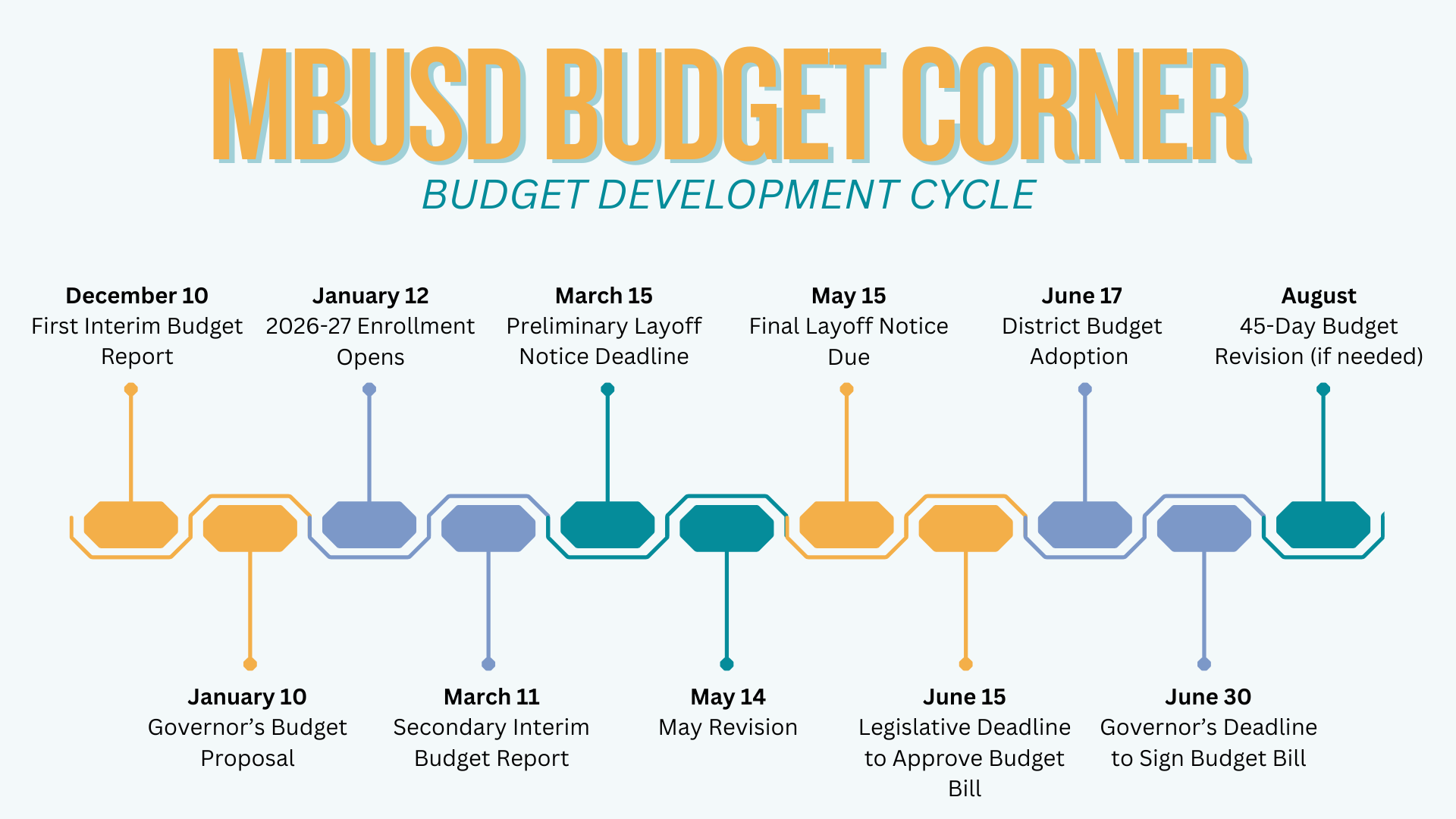
- In December: The District provides its First Interim Budget Report, updating its budget to reflect actual revenues and expenditures from the first quarter of the fiscal year and adjusting its State-required Multi-Year Projection (MYP), describing the current and subsequent two fiscal years.
- In January: The Governor publishes his proposed State budget for the following fiscal year. This kicks off six months of budget negotiations at the state level, and while the Governor’s January proposal provides some indication of what the Governor hopes for, the uncertainties associated with legislative negotiations mean that, other than updating the projected COLA in alignment with the Governor’s proposal, school districts cannot confidently incorporate proposed funding into their budgets.
- In February: District leadership continues budget planning and develops recommendations, including staffing considerations, to ensure that it can maintain a positive ending fund balance of at least three percent. These recommendations are based on the information reflected in the First Interim Budget Report.
- By March 15: If required, preliminary reduction-in-force (RIF) staffing release notices are issued to employees in accordance with state-mandated timelines. In order to provide time to ensure this deadline is met, the Board must approve these notices earlier, generally in late February. These timelines must be followed even though the State and District budgets have not yet been finalized, and additional notices cannot be issued later in the year.
- In Mid-March: The District provides its Second Interim Budget Report. This update, generally due after preliminary RIF staffing release notices must be provided, may result in some relief from any projected budgetary reductions, but only where there is budget certainty. Throughout the spring, the District may be able to withdraw some preliminary RIF notices, but generally only where the resignation or retirement of more senior employees reduces the need for the layoff of less senior employees - these actions reduce the number of people on the RIF list but do not reduce the overall size of the reduction.
- In May: The District must provide its final staffing notices by mid-May, again ahead of final information about the State and District budget for the subsequent fiscal year. The Governor releases a revised budget proposal in May, revealing some indications of the state of negotiations with legislators. Often, but not always, the Governor’s May revision provides a somewhat reliable forecast of the State’s budget for the following year, but legislative negotiations continue over the subsequent six weeks.
- In June: The District must adopt its budget at its last Board meeting in June, which generally occurs prior to the State’s budget enactment at the end of June (by June 30).
- In July - August: The District refines its budget and staffing plans based on finalized State funding and shares final actions with the Board and community. Final budget information, including both additional revenue provided in the state budget and information about the District’s ending fund balance, including any areas where the District was able to spend less than anticipated, can result in the rescission of layoff notices.
Why Staffing Decisions Happen Early:
California law requires public school districts to follow specific notice deadlines related to staffing, regardless of when the State budget is finalized. While this process can feel early, these timelines are designed to ensure transparency, protect employee rights, and allow districts time to adjust plans once final funding levels are known.
While MBUSD has done extensive, thoughtful work to arrive at the current budget projections, these figures are always subject to change as new information becomes available at the State level and as we work to reduce spending both in the current and future years. The District continues to closely monitor budget updates and will adjust as needed to reflect the most accurate funding picture possible. However, because RIF staffing release notices can be rescinded but not increased after the March 15 statutory deadline, the District must be conservative in making its decisions until the final State budget is enacted and some budget certainty is provided.
In times like these, we encourage our community and families to stay involved and support our schools where they can. Community partnerships play a vital role in sustaining the exceptional experiences, access, and opportunities that make MBUSD such a special place for students to learn and grow.
First Interim and the Current Budget Reality | January 23, 2026
Each year, the District goes through several formal checkpoints to review and update its budget. One of the most important of these is the First Interim Budget Report, presented in December and required by the California Department of Education. This report provides the Board of Trustees, staff, and community with an updated picture of the District’s finances based on actual revenues and expenditures through October 31, along with projections for the rest of the current year and for the two fiscal years that follow.
What Is the First Interim Budget Report?
California school districts are required to prepare two interim budget reports each year to assess fiscal health and ensure ongoing solvency. The First Interim compares the budget adopted in June with updated financial data and revised assumptions, including changes in enrollment, staffing, revenues, and expenditures.This report serves as an early indicator of whether a district is on track to meet its financial obligations over the next three years. It also requires the District to certify its fiscal status and identify financial risks that must be addressed through future planning. While the First Interim is a snapshot in time, it is also a critical planning tool that helps shape staffing decisions, budget adjustments, and long-term strategies. As it provides the most updated data available, it is the information that must be used in planning for any staffing reductions that will need to be made before March 15.
How Did We Get Here?
In 2020, the District was in the process of making budget adjustments, when the pandemic provided increased funding and significant programmatic requirements that disrupted this process. Now, as the pandemic recedes into the past. On the revenue side, the District relies primarily on funding from the state through the Local Control Funding Formula (LCFF). Because MBUSD has a relatively low percentage of unduplicated pupils (UPP), the District receives significantly less supplemental and concentration funding than many neighboring districts, making its share of state funding lower than most other districts. This limits revenue growth even as operational costs continue to rise. While local funding sources such as parcel tax revenue and community support through organizations like the Manhattan Beach Education Foundation, PTAs, and MBX play an essential role in sustaining programs, these funds cannot fully offset long-term structural challenges in state funding.On the expenditure side, the majority of District spending supports personnel, including salaries and benefits for teachers, staff, and administrators who serve students each day. Rising costs in areas such as health and welfare benefits, pensions, utilities, and contracted services to support programmatic needs, including legally required services for students with disabilities, have continued to outpace revenue growth. Enrollment trends also affect both revenue and staffing needs, further tightening the budget.The 2025–26 First Interim Budget Report reflects updated multi-year projections showing that, without corrective action, ongoing expenditures would exceed revenues and District reserves would fall below Board policy and state-required levels. These projections prompted the Board to take proactive steps to address the imbalance between ongoing costs and available funding.
What Does the Path Forward Look Like?
In response to the First Interim findings, the Board adopted a Fiscal Stabilization Plan, which outlines a multi-year approach to restoring long-term financial stability. This plan acknowledges that the District is currently in a challenging position and that the road ahead will require difficult decisions. However, those decisions are necessary to ensure the District can remain fiscally solvent and continue to provide high-quality educational experiences over time.While these realities do not change the District’s commitment to students, curriculum, and enrichment opportunities, they will be felt in how educational programs and services are delivered and accessed in the coming years. The purpose of the Fiscal Stabilization Plan is not just to provide a short-term fix, but also to implement sustainable budgeting that protects core programs and avoids deeper disruptions in the future. The reality is that ongoing differences between state funding levels and the rising cost of programs and services mean the District will need to continue making thoughtful budget adjustments while working toward long-term revenue solutions.
What Comes Next?
- March 11 - Second Interim Budget Report: The Second Interim Budget Report provides another update to the District’s refined financial picture, incorporating updated enrollment and staffing assumptions for the next school year, updated expenditure projections, and new information about state funding based on the Governor’s January Budget Proposal. This report is an important milestone in determining whether planned actions can or should be adjusted to maintain fiscal stability.
- March 15 - Preliminary Layoff Notice Deadline: In order to allow sufficient time for the District to prepare and provide notice to employees in alignment with the March 15 deadline, the Board must take action in February, before the Second Interim Budget Report is available.
- May 14 - Governor’s May Revision: The May Revision updates the State Budget proposal and may include changes to education funding based on economic conditions and state revenues. This report remains a draft that discusses what the Governor hopes the State Budget will reflect; it is still subject to change at the legislative level. The proposals in the May Revision are carefully analyzed to determine whether they can or should be incorporated into District planning as staff prepare the budget for adoption in June.
- May 14 - Final Layoff Notice Deadline
- June 15 - Legislative Deadline to Approve Budget Bill
- June 17 - District Budget Approval
- June 30 - Governor’s Deadline to Sign Budget Bill
- August - 45-Day Budget Revision as Needed
The District will continue to monitor revenues and expenditures closely and share updates through Budget Corner to support transparency and timely communication to keep the community informed as this work continues.
The Governor's Budget and What It Means for Our District | January 30, 2026
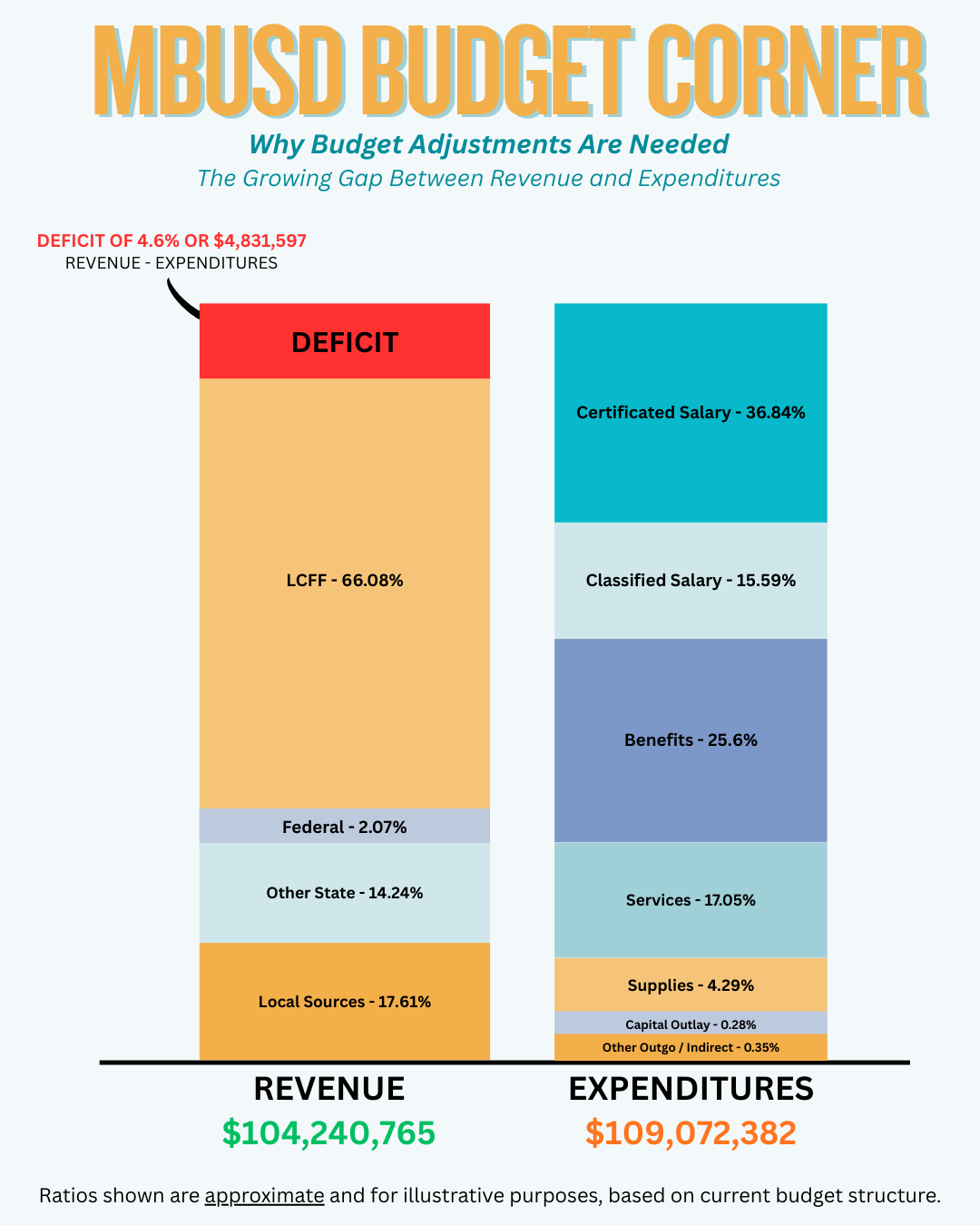
MBUSD is facing a very challenging budget situation and must take action to address a projected $6.8M shortfall. The Board of Trustees must make difficult decisions over the next few months, and it is critical that everyone in our community understands the background and context that will set the stage for these decisions. Over the past few weeks I have provided some of this information. Today’s story provides an update on the recent release of the Governor’s January Budget proposal and what it means for MBUSD.
Each year, the State of California develops a budget that determines how much funding school districts receive. One of the most important milestones in that process is the Governor’s January Budget, which provides an early look at proposed funding levels and statewide priorities for the coming school year.
What is the Governor’s Budget?
The Governor’s Budget is a proposal, not a final decision. Released each January, it outlines:
- How much revenue the state expects to collect
- How funds may be allocated across programs, including K-12 education
- Assumptions about the economy, enrollment, staffing, and cost increases
For school districts, this proposal sets the starting point for planning, not the finish line.
How is the Budget Formed?
The state budget is shaped by several key factors, including:
- State revenues (primarily income and sales taxes)
- Economic conditions and forecasts
- Required obligations, such as pensions and health benefits
- Education funding laws, including the Local Control Funding Formula (LCFF)
- Legislative priorities, including those supported by the Governor and by individual members of the Assembly and the Senate
Because LCFF funding is largely based on student enrollment and specific student needs, districts like MBUSD which receive limited supplemental and concentration funding often feel state funding constraints more acutely than neighboring districts.
How does this Process Affect MBUSD?
The Governor’s January Budget helps MBUSD:
- Begin scenario planning for the next school year
- Estimate potential funding levels while acknowledging uncertainty
- Align staffing, programs, and services with likely resources
Importantly, district budget decisions must be made months before the state budget is finalized. This means MBUSD must plan conservatively, using the best information available at the time, while remaining flexible as new information emerges.
What is included in the Governor’s Budget, and how will it impact MBUSD?
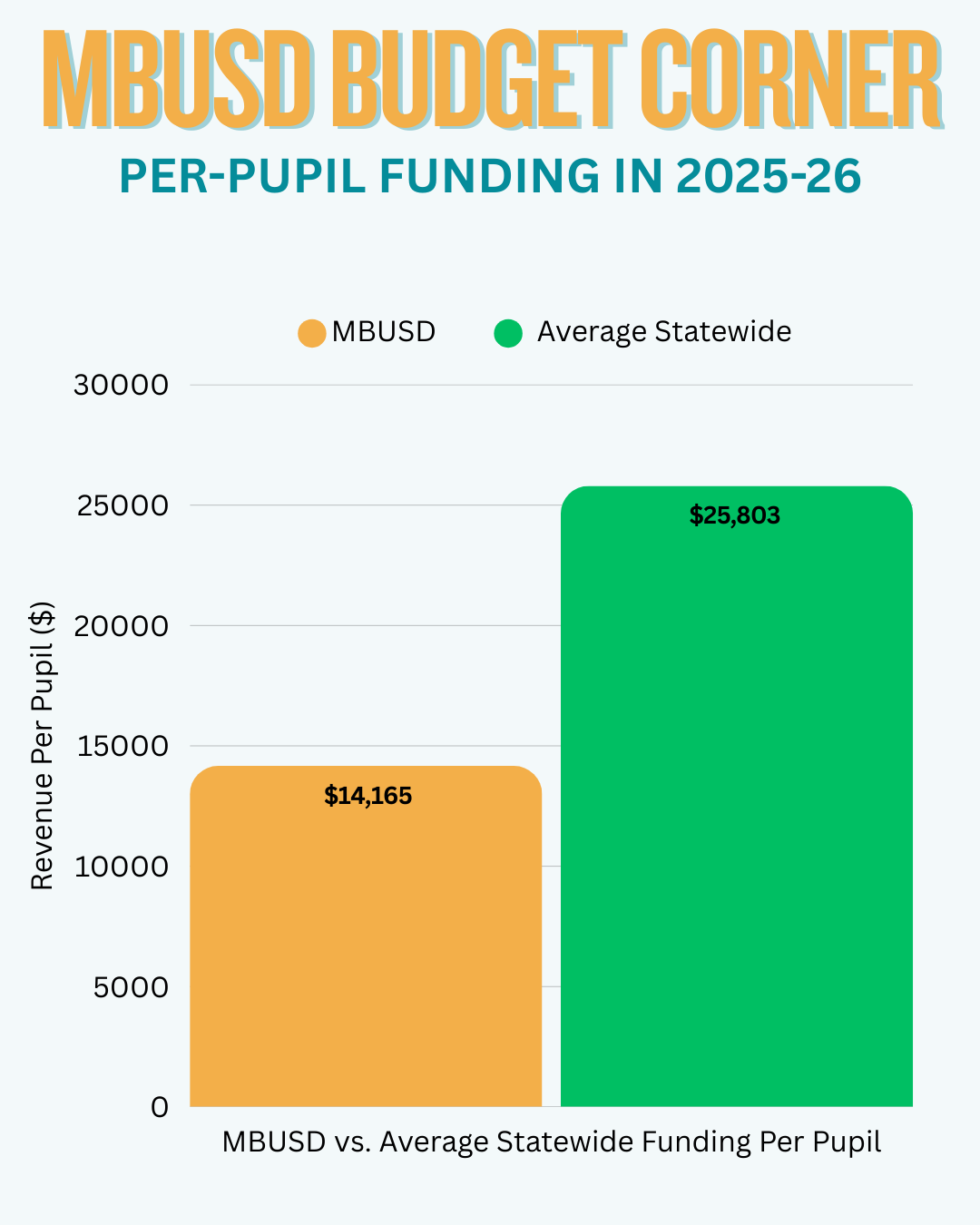
The Governor’s budget says that, if his proposals are accepted, “TK-12 per pupil funding totals $20,427 from the Proposition 98 General Fund, a 74.6 percent increase over 2018-19, and $27,418 per pupil when accounting for all funding sources, a 60.8 percent increase over 2018-19.” It is important to understand that, for MBUSD, state revenues in 2025-26 amount to $14,165 per pupil, as compared with a 2025-26 statewide amount of approximately $25,803 per pupil.
When the Governor talks about per-pupil funding, he is referring to all state-funded programs, including many that MBUSD does not receive - programs such as Community Schools, the Equity Multiplier, Wildfire Recovery, and Targeted Assistance. These figures also include funding that is allocated based on school districts’ Unduplicated Pupil Percentages, including LCFF Supplemental and Concentration Grant funding, ELOP funding, and Literacy Coaches and Reading Specialists Grant Program funding.
For MBUSD, the specific proposals that will have an impact on our finances include:
- A decrease in the projected COLA, applied to LCFF funding and other funding streams, meaning we will get less than we previously anticipated
- A discretionary block grant, which if distributed on an ADA basis would provide significant one-time funds to help us slow expenditure reductions. However, there is some discussion that these funds should be reduced and/or distributed based on districts’ Unduplicated Counts
- The final restoration of one-time Learning Recovery Emergency Block Grant funding that was previously allocated and then pulled back mid-year; this would provide the District with approximately $75,000 in additional one-time funding
- Stabilization of funds to support the state’s required Extended Learning Opportunity Program; MBUSD is considered a “Tier 2” district because of its Unduplicated Count and previously received a proportional share of what was left from this budget after districts with higher unduplicated counts received their share; the Governor proposes establishing a consistent per-pupil amount for Tier 2 districts. This would help the District to minimize contributions from the General Fund to support provide ELOP mandated services
Additionally, the Governor proposes to withhold approximately $5.6 billion in funds that should be allocated to education under the Constitutional requirements set by Proposition 98. This “maneuver” creates long term funding instability for education, and is being debated by various education advocates. While a reversal of this proposal would strengthen education finances over time, it would create a budget problem for the State in the current year that could result in reductions to education spending in the short term (creating a “maintenance factor” that the State would repay over time).
What does this Mean for District Budget Decisions?
While the Governor’s January Budget proposal provides valuable insight, it is the Governor’s first draft. His proposal kicks off six months of negotiations informed by legislators and their constituents. Other than the COLA, which is statutorily defined and updated based on new data, none of the components of the January Budget become definite until the budget is enacted in law in June.
As a result, the District typically does not incorporate proposed funding into its budget until its June Adopted Budget and generally does not count on this funding to address budget challenges until that time.
How to Stay Informed?
We will continue to share updates as the state budget process moves forward, including how changes at the state level affect MBUSD’s planning and decision-making. Transparency and shared understanding are essential as we navigate this work together.
To help clarify how this unfolds, here’s an overview of the annual state budget timeline:
- January: Governor releases the proposed budget
- February - April: Legislative review, public hearings, and analysis
- Mid-May: The May Revision updates the proposal based on the latest economic data
- June: Legislature negotiates and passes a budget
- Late June: Governor signs the final budget
- July 1: New state fiscal year begins
This evolving timeline is why district budgets are not static and need to be updated and refined as state information becomes clearer.
Reduction-In-Force (RIF) and Understanding the Process | February 6, 2026
In recent months, the Board of Trustees has heard reports on the District’s budget as well as the Governor’s January Budget Proposal. These reports have drawn a stark picture of MBUSD’s financial situation. The District must make significant expenditure reductions that will be extraordinarily challenging in their impact to the programs and services that we provide to our students.
Because 80% of the District’s budget is invested in personnel costs, and because most of our other costs are either fixed costs or paid for by funds that can only be used for certain purposes, the District’s expenditure reductions will largely focus on personnel reductions. These reductions will impact class size in a significant way for the 2026-27 school year, especially at the secondary level, but also at the elementary schools. We will also see reductions in many support roles, including roles in site and district administration as well as classroom, office, and campus support roles.
While many components of our budget are not yet certain (including the impact of expenditure reductions we are working to implement in the current year, as well as the impact of a number of proposals included in the Governor’s Budget which remain under negotiations at the legislative level), the law requires that we take action to begin to implement staffing reductions planned for 2026-27 by March 15 of the current year.
Consequently, we will be implementing a process known as a Reduction-in-Force (RIF) prior to the statutory March 15 deadline. We want to take a moment to explain what a RIF is, why it occurs, and how the process works.
What is a RIF?
A RIF is a formal process used by school districts when projected revenues are not sufficient to sustain current staffing or programs. It is a budget-driven action, not a reflection of employee performance, and is governed by state law and collective bargaining agreements.
In MBUSD’s case, this situation is driven by both revenue limitations and rising expenses. Projected revenues are not sufficient to sustain current expenditure levels, and this is compounded by increased costs across multiple areas. Together, these factors have created a structural imbalance in the budget, making a RIF necessary to align ongoing expenditures with available resources.
Why do districts use a RIF process?
Districts are required to adopt a balanced budget and demonstrate fiscal solvency for the current and two fiscal years. When ongoing expenditures, such as staffing, exceed available funding, districts must consider adjustments to ensure financial stability and protect instructional programs.
MBUSD is facing the necessity for a RIF because of a structural challenge that has been in place for many years. The Local Control Funding Formula, which provides most of the funds that school districts receive from the state, is structured on an equity model, providing significant additional funds to districts with more students identified as needing additional support (English Learners, Foster Youth, and students from socioeconomically disadvantaged backgrounds). This makes MBUSD among the lowest-funded districts in the state. While inadequacy in education funding affects all schools, it affects MBUSD particularly strongly, and COLA-only increases to revenue have brought us back to the challenging circumstances that some community members might remember the District facing in 2019-20.
Additionally, expenditures have increased significantly in recent years, exacerbating the challenges presented by the state funding structure. Inflation has impacted the cost of goods and services, but in addition to this there have been outsize impacts to expenditures in specific areas, including utility costs, insurance premiums, pension costs, and special education costs. All of these areas are legally mandated and/or required to support basic district functions, and the District must meet these mandates, regardless of cost.
Combined, these factors have put the District in a position of needing to implement a RIF.
How does the RIF process work?
The RIF process follows clearly defined legal and contractual steps, including:
- Careful financial analysis to determine whether staffing adjustments may be necessary
- Review of staffing assignments and credentials to ensure programs remain supported
- Adherence to state law and collective bargaining agreements, which outline timelines, notice requirements, and employee rights
- Board of Trustees action, which must occur in public session and follow prescribed deadlines
The District has looked at every position in the District to determine which positions will be impacted by the current RIF. Following this, an analysis is conducted to determine which individuals will be provided notices; this is a strictly regulated process determined largely by seniority - again, notices are governed by law and collective bargaining agreements and have nothing to do with employee performance.
Following this analysis, preliminary RIF notices must be provided to affected employees prior to March 15. These notices are intended to inform employees of what is being planned so that they, in turn, have the opportunity to make plans for next year as necessary. However, RIF notices are not considered final until a second notice is provided prior to May 15.
What about the human impact?
A RIF is not an easy or desirable process. We understand that students, families, and our broader community feel deeply connected to and supported by the dedicated staff who serve our schools every day. This reality is not lost in the budget development process. Staffing decisions are among the most difficult a school district can face, and they are approached with care, respect, and an understanding of their very real impact on people and school communities.
What happens after a RIF is approved?
A preliminary Reduction in Force (RIF) notice is based on current financial projections and does not necessarily reflect a final outcome. As enrollment, funding, and staffing needs continue to evolve, the District may be able to adjust, rescind, or reassign positions prior to the start of the school year.
At its meeting on Wednesday, the Board was introduced to the concept of a Supplemental Early Retirement Plan (SERP) as a potential option. Any SERP would require Board approval and sufficient staff interest, but could provide a fiscally responsible way to support veteran teachers and staff considering retirement while helping the District retain newer educators who are facing RIF notices.
We continue to encourage families and community members to support educational partners like MBEF whenever possible so that they can advance their mission and help sustain programs and services for students. Community support plays an important role in strengthening educational opportunities, supporting educators, and enhancing the overall student experience, especially during challenging fiscal times.
How to Stay Informed?
We will continue to share updates as the state budget process moves forward, including how changes at the state level affect MBUSD’s planning and decision-making. Transparency and shared understanding are essential as we navigate this work together.
March 15 Preliminary Notices and Next Steps in the Budget Process | March 9, 2026
On February 25, the Board made the difficult decision to approve a series of resolutions related to preliminary Reductions in Force. The preliminary reductions are as follows: 40.4 Certificated FTE positions, 15.45 classified FTE positions, and 3 Administrative positions. There will be an update to the budget at the Board meeting on March 11. The First Interim budget covers the period from July 1st through October 31, 2025, while Second Interim budget covers the period from November 1, 2025, through January 31, 2026. The Second interim budget will provide more recent information, but until the State enacts its budget, revenues for next year will remain uncertain.
The District completed the distribution of the preliminary "March 15th notices" to affected staff last week. This action ensures the District remains in full compliance with state education code requirements regarding potential Reductions in Force (RIF) for the upcoming academic year. As presented, the issuance of these notices is a legally mandated, precautionary measure driven by budgetary constraints and the expiration of specific grant/supplemental funding. It is important to emphasize that a March 15th notice is a preliminary notification, not a final termination of employment. It preserves the District's legal flexibility to analyze the budget while we await finalized funding figures.
Affected staff members were provided with informational packets outlining their rights and the statutory timeline. District HR and site administrators are actively making themselves available to answer questions and provide support. All employees who received a notice have the right to request an administrative hearing to verify the accuracy of the seniority list and the procedural execution of the notices.
If trends suggesting an improved financial outlook continue as projected, or if the District’s financial outlook improves or staffing reductions are achieved through attrition (resignations and retirements, including the District’s Supplemental Early Retirement Program, if it moves forward), the District will carefully review its updated financial position and determine how any additional resources may best support District priorities.
While improved conditions may allow the District to reconsider preliminary notices, any decisions will be made only after thoughtful evaluation of the budget outlook, staffing needs, and long-term financial stability. If necessary, final layoff notices would be presented to the Board on April 29 and issued by the May 15 statutory deadline.
Second Interim Budget Update | March 16, 2026
Each year, school districts across California update their budgets several times as new information becomes available. The Second Interim Budget Report serves as a mid-year checkpoint, allowing districts to revise projections based on updated data about enrollment, state funding, staffing needs, and rising operational costs.
While the District’s current projections show some improvement over earlier estimates, MBUSD—like many school districts throughout California—continues to face significant financial pressures now and in the next three years. Understanding the factors that influence school funding helps provide context for the decisions districts must make.
One of the most important drivers of school district revenue is the Local Control Funding Formula (LCFF), the state’s primary funding system for public schools. Under LCFF, funding is largely based on student enrollment and specific student populations. Compared to other unified school districts, MBUSD receives less funding per student. The countywide median among unified districts is $13,610 per student, and the statewide median is $14,421, compared to MBUSD’s $11,657 per student. This structural funding gap means the District must operate with fewer state resources than many other districts.
At the same time, districts across California are experiencing increasing cost pressures. These include rising energy and utility costs, pension obligations, employee salaries and benefits, special education services, and property and liability insurance. Like households and businesses, school districts must manage these growing expenses while maintaining programs and services for students.
Special education services are one area where costs have grown significantly across the state. In response, MBUSD has taken steps to carefully review service needs and ensure staffing and support align with each student’s Individualized Education Program (IEP) while also monitoring service delivery and billing processes.
Another important factor affecting the District’s financial planning is the State of California’s annual budget process. The Governor’s proposed budget includes adjustments such as a Cost of Living Adjustment (COLA) for school funding, which applies to LCFF, special education, and certain categorical programs. However, many aspects of the state budget will remain uncertain until it is finalized later in the spring, which means school districts must plan for multiple possible funding scenarios.
Advocacy at the state level also plays an important role in shaping future funding. School districts across California—including MBUSD—are supporting efforts to increase base funding through a coalition called Raise the Base. These efforts include advocating for stronger long-term school funding, additional support for special education, and adjustments to how certain state funds are distributed.
One of the most challenging aspects of financial planning right now is balancing several competing priorities. The District must work to reduce the structural deficit and strengthen budget reserves in order to protect against deeper financial challenges and potential reductions in the future. At the same time, there is a strong desire across the community to maintain programs, support reasonable class sizes, and minimize staffing impacts whenever possible, including consideration of rescinding Reduction in Force (RIF) notices if financial conditions allow. These decisions are further complicated by a number of rising cost pressures affecting school districts statewide, including increases in energy and utility costs, pension obligations, employee salaries and benefits, special education services, and property and liability insurance.
Locally, the District must also consider enrollment trends, which directly affect revenue, as well as the need to maintain appropriate budget reserves. Reserves act as a financial safety net, helping districts manage economic uncertainty, unexpected costs, and fluctuations in enrollment or state funding.
Because many factors—including the final state budget and next year’s enrollment numbers—will not be known until later this spring and summer, financial planning requires ongoing adjustments. District leadership will continue to monitor these variables closely as part of a long-term effort to maintain financial stability while continuing to support high-quality educational programs for MBUSD students.
We recognize that conversations about school funding and budgets can be complex, and we are deeply grateful for the continued support and engagement of our community during this challenging time. Manhattan Beach has always been a community that values strong public schools, and we appreciate the thoughtful input, ideas, and advocacy we have seen from families, staff, and community members. As we navigate the months ahead, we remain committed to transparency and welcome continued dialogue as we work together to support our students and schools.
Second Interim Budget Update (continued) | March 23, 2026
MBUSD is continuing to monitor and engage in conversations at the state level regarding public school funding. As part of this effort, the District has shared a letter with state legislators outlining considerations related to base funding levels, funding adequacy and equity, and the potential impacts of proposed changes to the Local Control Funding Formula (LCFF), as well as ongoing cost pressures facing school systems.
In addition, MBUSD is participating in broader, statewide conversations focused on understanding public school funding. The District has joined a collaboration of school districts and organizations, known as Raise the Base, who are working to provide information and raise awareness around funding structures and challenges impacting public education.
Interested in learning more about school funding? MBUSD is offering an opportunity to receive additional information and updates related to school funding. Complete this form to receive additional information and updates. Information submitted may also be shared with partner organizations, including MBEF, MBX, and the MB Council of PTAs, for related informational outreach.